
How to Wear Cufflinks With Business Casual
Last Updated: October 23, 2026
Quick Summary
How to wear cufflinks with business casual requires three key steps: choose a shirt with French, double, or convertible cuffs; select understated cufflink designs in polished or brushed metal; and coordinate the cufflinks with your watch, belt, and other accessories to create an intentional, refined look without appearing overdressed.
- Wear cufflinks only with French, double, or convertible cuff shirts, standard button-cuff shirts won't accommodate them.
- Choose polished silver, brushed metal, or gold-tone cufflinks with a 16mm face diameter as the reliable standard size.
- Match your cufflink metal to your watch, belt buckle, and rings to avoid the most common styling error of mismatched metals.
- Pair understated cufflinks with tailored dress shirts and trousers; avoid formal cufflinks with casual clothing like polos or t-shirts.
- In conservative offices choose polished simple designs; in relaxed offices choose small, matte, or silk-knot styles to match the setting.
Table of Contents
- Understanding Cufflinks and Business Casual
- What Shirts Work With Cufflinks
- Can You Wear Cufflinks Without a Suit
- Business Casual Cufflink Etiquette
- How to Fasten and Align Your Cufflinks
- Choosing Cufflink Styles and Materials for Your Outfit
- Common Mistakes to Avoid
- Conclusion
- Frequently Asked Questions
Understanding Cufflinks and Business Casual
Cufflinks are small fasteners that hold dress shirt cuffs closed, replacing buttons on shirts designed for formal wear.
The modern professional often seeks ways to elevate understated outfits. Cufflinks do exactly that, signaling attention to detail without a full suit.
The challenge is balance: the wrong cufflink or shirt makes you look headed to a black-tie event instead of the office.
What Shirts Work With Cufflinks
Not every dress shirt accepts cufflinks. Standard button-cuff shirts won't work. You need a shirt with French cuffs, double cuffs, or convertible cuffs, the only styles designed to hold cufflinks in place.
French, Double, and Convertible Cuffs Explained
French cuffs are the most common style for cufflinks. The cuff folds back on itself, creating a double layer of fabric with two buttonholes aligned on the outside.
Convertible cuffs offer flexibility: they have both buttons AND buttonholes, so you can wear them buttoned for a casual look or folded back with cufflinks for a more formal appearance.
For business casual, French or convertible cuffs work best, they signal intention without demanding a full formal outfit.
Can You Wear Cufflinks Without a Suit
The short answer is yes.
Cufflinks were originally formal wear accessories, appearing on tuxedo shirts and dress shirts worn with suits and evening wear.
Business casual has changed that equation. Wear cufflinks with dress pants and a blazer, or with tailored trousers and a dress shirt and no jacket.
What matters is intentionality.
The mistake is pairing formal cufflinks with casual clothing, a bold, ornate cufflink with a polo shirt looks mismatched.
Business Casual Cufflink Etiquette
Workplace dress codes vary widely, and most offices sit in business casual territory. Most cufflink advice treats "business casual" as one thing, in practice, expectations shift with your office, industry, and calendar. Here's how to read the room.
Read your office's formality tier first
Think of business casual as a spectrum with three practical tiers. Cufflinks are appropriate in all three, but the style and the rest of the outfit should shift with the tier.
Conservative business casual (banking, law, consulting, insurance, many corporate headquarters). The baseline is a tailored dress shirt, dress trousers, and often a sport coat.
Standard business casual (most corporate offices, sales roles, mid-size professional firms). The baseline is a button-down or dress shirt with chinos or dress trousers, jacket optional.
Relaxed business casual (creative agencies, tech companies, startups, media). The baseline may include knitwear, open-collar shirts, and even clean sneakers.
Match the cufflink to the occasion, not just the office
Even within one office, the right call changes day to day:
- Client meetings and presentations. Cufflinks earn their keep here, signaling respect for the occasion. Choose your most restrained pair, polished silver, simple shape, with a freshly pressed shirt.
- Internal meetings and normal office days. Optional. If you wear them, keep them subtle; being the only person wearing them is fine as long as the rest of your outfit doesn't announce it.
- Casual Fridays. Usually the wrong call unless your casual Friday still involves a collared shirt and tailored trousers. If jeans and a polo are the norm, leave them in the drawer.
Industry norms worth knowing
- Finance, law, and consulting tend toward the conservative tier. Cufflinks are common and expected in client-facing roles. Silver or gold-toned metal, simple designs.
- Corporate management and sales sit in the standard tier. Cufflinks are a nice touch but not required. Understated metal works best.
- Creative, tech, and media sit in the relaxed tier. Cufflinks are a personal-style choice. Small, matte, or silk-knot styles fit best; flashy metal can look out of place.
The etiquette rules that don't change
Regardless of tier, a few rules hold:
- Cufflinks are a choice, not a requirement. In business casual, they should look like a deliberate finishing touch, not a uniform requirement.
- One statement piece per outfit. Keep your tie, pocket square, and watch understated and let the cufflinks be the detail people notice.
- Skip novelty and humor in the office. Save the dice, tiny tools, and cartoon characters for personal wear; in a professional setting, restraint reads as confidence.
How to Fasten and Align Your Cufflinks
Fastening cufflinks takes practice, but the mechanics are straightforward.
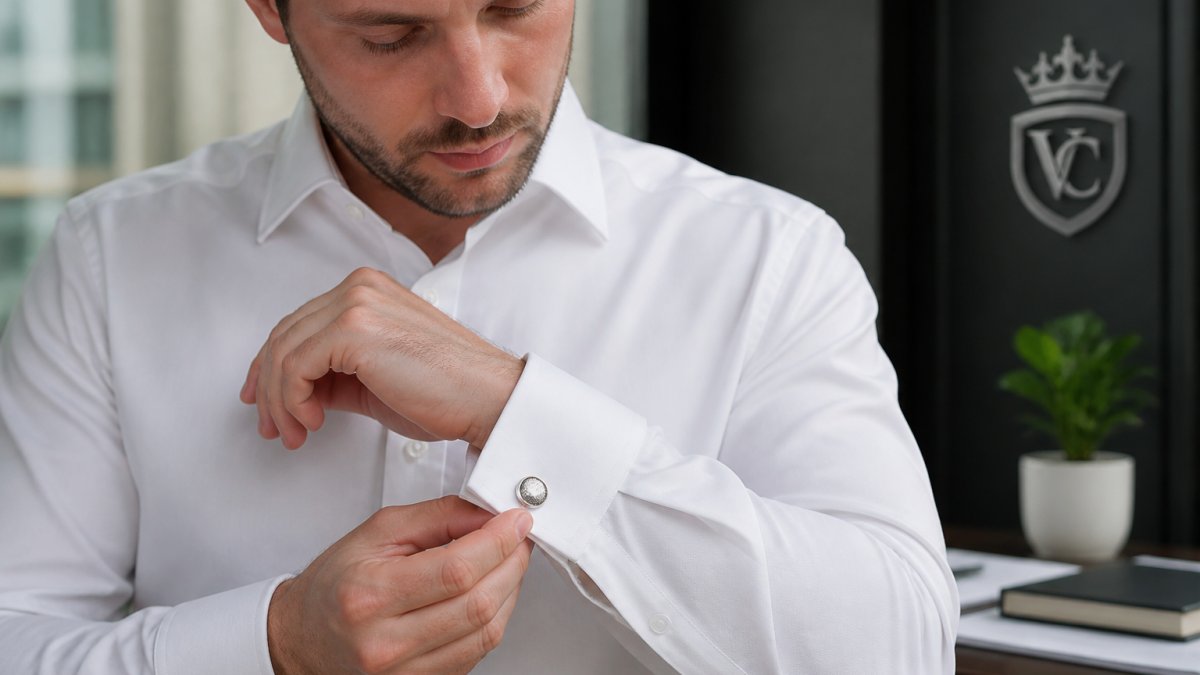
Fold your cuff back on itself to create a double layer of fabric.
Executive Crown Sterling Silver Cufflinks →
Hold the cufflink so the post (the bar connecting the two decorative faces) points toward the cuff. Slide the post through the top buttonhole from the outside, then thread it through the bottom buttonhole from the inside of the cuff outward.
Once the post passes through both holes, the decorative faces sit on either side of the folded cuff.
Alignment matters: the decorative faces should sit flat against the cuff, not twist or angle awkwardly, or the cufflink won't close properly and will look sloppy.
A common mistake is threading the post through only one buttonhole, usually from an incomplete fold or rushing.
Choosing Cufflink Styles and Materials for Your Outfit
Your cufflinks' style and material should complement your overall look, not compete with it. In business casual, the goal is a cufflink that reads as refined at arm's length and disappears into the outfit at a glance, which means the right scale, finish, and metal.
Start with scale
Cufflink size is the most overlooked variable: too large looks theatrical, too small disappears under the cuff. A 16mm face diameter is a reliable standard for most men. Larger wrists or wider cuffs can take 17-18mm; smaller frames or slim-cut shirts should stay at 15-16mm. The cufflink should sit within the folded cuff without overhanging the fabric edge.
Choose the finish to match the outfit's formality
- Polished silver or white gold tone: the most versatile finish, working with gray, navy, charcoal, white, and light blue shirts. The default for conservative and standard business casual.
- Brushed or matte metal: reads slightly more casual, good for relaxed offices, oxford-cloth shirts, and outfits with knitwear or chinos.
- Gold tone or vermeil: warmer and more traditional, pairing especially well with navy, charcoal, cream, and warmer shirt tones. Works in all three tiers if the design is simple.
Coordinate with your other metals
The single most common styling error is mismatched metals. Your cufflinks should relate to your watch, belt buckle, and any rings.
- Silver watch and silver buckle: choose silver or white-gold-tone cufflinks.
- Gold watch and buckle: choose gold-tone or vermeil cufflinks.
- Mixed metals (a two-tone watch, for example): choose two-tone cufflinks or pick the metal matching your watch's dominant tone.
A simple test: hold the cufflink next to your watch in daylight. If they look like they belong to the same outfit, you're set; if one makes the other look dull or off, switch.
Coordinate with casual accessories
Business casual often includes accessories that formal outfits don't: a leather-strap watch, a canvas or leather belt, sometimes a subtle bracelet. Keep the palette tight.
- Belt and shoes should match each other (brown with brown, black with black). Your cufflinks should match the metal of your belt buckle, not the leather.
- Watch is the anchor. Match cufflink metal to watch metal as above.
- Bracelets and rings should stay minimal if you're wearing cufflinks. One metal accent per wrist is enough.
Outfit formulas that work
Concrete combinations take the guesswork out of business casual cufflinks. These formulas work across all three tiers.
Formula 3, The blazer-and-knitwear layer. Fine-gauge crewneck or V-neck sweater over a cufflink-compatible shirt, tailored trousers, simple metal cufflinks, leather shoes.
Formula 4, The creative-office statement. Patterned or textured shirt with French cuffs, dark jeans or tailored chinos, clean leather sneakers or loafers, small matte or two-tone cufflinks.
A note on materials and longevity
Sterling silver and gold vermeil hold up best over years of wear. Sterling silver develops a soft patina many professionals prefer and can be polished back to a bright finish with a jeweler's cloth. Vermeil, sterling silver with thick gold plating, offers warmth at a lower cost than solid gold. Base-metal cufflinks with thin plating tend to flake or discolor at the edges, visible at close range in meetings.
Common Mistakes to Avoid
Mistake: Wearing cufflinks with a standard button-cuff shirt. Without French or convertible cuffs, cufflinks won't work, and forcing them creates a sloppy appearance.
Mistake: Neglecting to align the cuff properly. A twisted or misaligned cuff makes the whole outfit look careless.
Mistake: Wearing overly decorative cufflinks in a conservative office. Novelty designs, bright colors, or elaborate patterns read as unprofessional in formal environments.
Mistake: Forgetting to secure the backing. A cufflink without a properly closed backing will slip off.
Conclusion
How to wear cufflinks with business casual comes down to three principles: choose the right shirt, select understated designs, and coordinate thoughtfully with your overall outfit. Cufflinks are no longer reserved for black-tie events. They've become tools for professionals who want to signal discipline and attention to detail in everyday business settings.
VALCREST™ cufflinks are designed for exactly this purpose. Whether you choose the Executive Crown or Founder's Edition Shield, you're investing in pieces that elevate business casual without demanding a formal occasion. Shop the Collection

Frequently Asked Questions
Are cufflinks appropriate for a business-casual office?
Yes, cufflinks work in business-casual settings when paired with the right shirt and style. Choose understated designs in silver or subtle gold finishes rather than ornate or oversized pieces. The key is selecting cufflinks that feel proportional to your outfit and workplace culture. If your office leans formal within business casual, cufflinks signal attention to detail and professionalism. Start with one pair in a classic style, like the Executive Crown Cufflinks in silver, to test how they feel in your environment.
What kind of shirt do you need to wear cufflinks?
Cufflinks require shirts with French cuffs, double cuffs, or convertible cuffs, never standard barrel cuffs with buttons. French cuffs fold back on themselves and have buttonholes instead of buttons, creating two layers that hold cufflinks securely. Double cuffs are the British term for the same style. Convertible cuffs work with both buttons and cufflinks, giving you flexibility. Look for dress shirts or business casual shirts specifically designed with these cuff styles. The fabric should be substantial enough to hold the weight of the cufflink without tearing.
Can you wear cufflinks without a suit?
Absolutely. Cufflinks work perfectly with blazers, sports coats, sweaters, or even standalone dress shirts in business-casual settings. The key is balance: if you're wearing cufflinks without a suit jacket, choose understated designs and pair them with neutral colors. A dress shirt with cufflinks and a blazer creates a polished look without feeling overly formal. Avoid pairing ornate or large cufflinks with casual pieces like cardigans or lightweight sweaters, as this creates visual discord. The outfit's formality level should match the cufflink's visual weight.
How do I know if my cufflinks will actually last?
Quality cufflinks are crafted from sterling silver or sterling silver with gold vermeil, materials that resist tarnishing and wear when properly cared for. Look for fixed-post closures or whale back mechanisms rather than cheap chain designs that break easily. VALCREST™ cufflinks, for example, are meticulously constructed to endure decades of wear. Check that the posts are secure and the closure mechanism moves smoothly without wobbling. Solid craftsmanship, premium materials, and a maker's commitment to heritage ensure your investment becomes an heirloom piece.